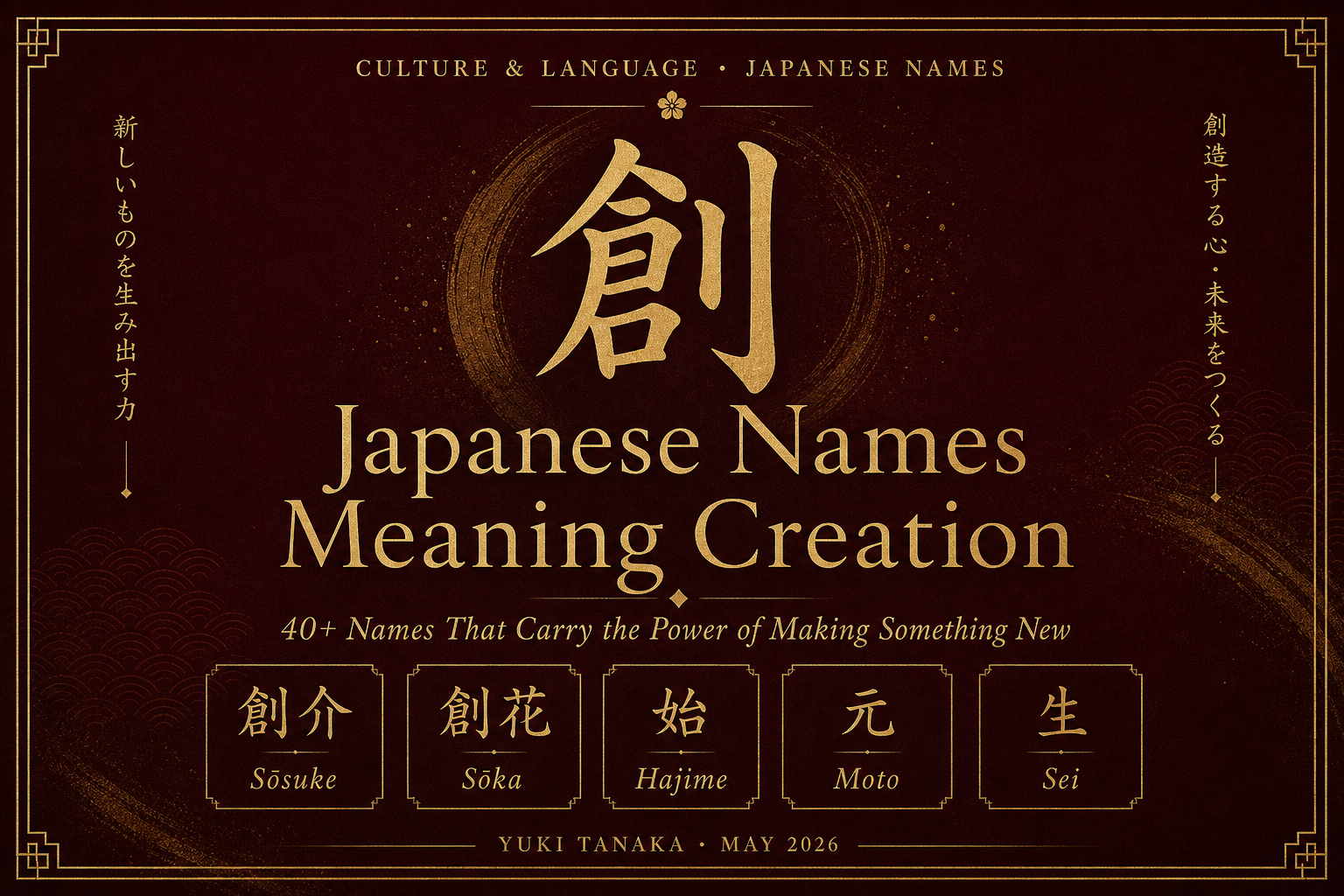
Explore 40+ Japanese names rooted in creation, origin, and new beginnings, with kanji, readings, and the stories behind names like Sōsuke, Tsukuru, Sōka, and Hajime.
There's something quietly profound about naming a child, or a character, or yourself, after the act of creation itself. In Japanese culture, names aren't chosen lightly. Every kanji carries centuries of meaning, and when parents sit down to pick a name, they're really asking: what do we want this person to bring into the world?
Names that mean creation, birth, or making something new are among the most beloved in Japan. They carry optimism. They suggest a person who doesn't just exist in the world, they add to it.
In this guide, we've pulled together over 40 Japanese names with meanings rooted in creation, origin, building, and new beginnings, for boys, girls, and gender-neutral choices. Each entry includes the kanji, the reading, and the story behind why it works. Whether you're naming a baby, writing a character, or just curious about the language, you're in the right place. You can also browse our full Japanese first names database for even more inspiration.
Why "Creation" Is Such a Meaningful Theme in Japanese Names
Before we get into the names themselves, it helps to understand why this theme resonates so deeply in Japanese naming culture.
Japanese names are built from kanji, Chinese characters adapted into the Japanese writing system, and each character comes loaded with meaning. When you pick a name like Sōsuke or Tsukuru, you're not just picking a sound. You're choosing a value, an aspiration, a prayer.
The kanji associated with creation fall into a few natural groups:
- 創 (sō/tsuku): to create, to found, to originate
- 生 (sei/i/u): life, birth, to give rise to
- 造 (zō/tsuku): to construct, to make, to build
- 元 (gen/moto): origin, source, root
- 始 (shi/hajime): beginning, to start
- 新 (shin/atarashi): new, fresh, renewal
These aren't just abstract concepts, in Japanese tradition, a name with these characters is seen as shaping the person who carries it. For a deeper understanding of how kanji work in naming, check out our article on what Japanese names really mean.
Japanese Boy Names Meaning Creation
These names are traditionally masculine and carry strong creative, founding, or generative energy.
Sōsuke (創介)
Meaning: Creation + help, mediate | Say it: SOH-soo-keh
The kanji 創 (creation) paired with 介 (help, mediate) gives Sōsuke a beautiful nuance: someone who helps bring new things into existence. It's a popular name in modern Japan, anime fans may recognize it from Fullmetal Alchemist, and it ages gracefully from childhood into adulthood.
Tsukuru (創)
Meaning: To create, to make | Say it: TSOO-koo-roo
Simply meaning "to create" or "to make," Tsukuru is one of the most direct name choices in this theme. It became widely recognized internationally after Haruki Murakami used it as the protagonist's name in his novel Colorless Tsukuru Tazaki. The name feels modern and literary.
Hajime (創 / 始)
Meaning: Beginning, first | Say it: hah-JEE-meh
Hajime means "beginning" or "first", the moment something comes into being. Written with 創, it leans toward creative origin; written with 始, it emphasizes a fresh start. Either way, it's a name with real warmth and forward motion. A classic that never feels dated.
Sōsei (創生)
Meaning: Creation, genesis | Say it: SOH-say
創生 directly translates to "creation" or "genesis", it's the word used in the Japanese title of the Bible's Book of Genesis. As a name, it carries enormous weight: a person who brings a world into being. Powerful, a little rare, and deeply memorable.
Haruki (春生 / 陽生)
Meaning: Born of spring / child of sunlight | Say it: hah-ROO-kee
Haruki is one of Japan's most beloved names (yes, like the author). Written with 生 meaning "born of spring" or "child of sunlight," it speaks to natural creation and the emergence of new life. It's warm, optimistic, and has genuine staying power.
Motoki (元樹 / 基樹)
Meaning: Origin tree, founding tree | Say it: moh-TOH-kee
元 means "origin" or "source" and 樹 means "tree", together, Motoki evokes the idea of a founding tree, the root from which everything else grows. It's a grounded, earthy name with quiet creative strength.
Kazuki (和生 / 一樹)
Meaning: Peaceful birth, harmony born | Say it: kah-ZOO-kee
With 生 (life, birth) as a core character, Kazuki is a name of vitality and new beginnings. The most common combination, 和生, suggests "peaceful birth" or "harmony born." It's consistently popular and pairs beautifully in everyday use.
Ryūsei (龍生 / 流星)
Meaning: Born of the dragon / shooting star | Say it: RYOO-say
生 (born) paired with 龍 (dragon) gives Ryūsei the meaning "born of the dragon", a creation myth in miniature. The alternate reading using 流星 (shooting star) adds a cosmic dimension. Either way, it's a name with genuine presence.
Zōichi (造一)
Meaning: First builder, founder | Say it: ZOH-ee-chee
造 (to construct, to build) combined with 一 (one, first) creates a name that means something like "the first builder" or "founder of something new." It's somewhat old-fashioned but carries a dignified, artisan quality that is coming back into fashion.
Genji (源氏)
Meaning: Source, origin | Say it: GEN-jee
源 means "source" or "origin", the wellspring from which things flow. Genji is the name of Japan's most celebrated literary hero (The Tale of Genji, written around 1000 CE). It carries history, nobility, and the sense of being the origin of something great.
Japanese Girl Names Meaning Creation
These names are traditionally feminine and carry the creative spirit in softer, often more lyrical ways, though no less powerful for it.
Sōka (創花)
Meaning: Creation + flower | Say it: SOH-kah
創 (creation) meets 花 (flower) in this elegant name, a flower that creates, or the creation of something blooming. It feels fresh and poetic, carrying both creative energy and natural beauty. Increasingly popular among parents looking for something distinctive.
Izumi (泉 / 和泉)
Meaning: Spring, wellspring | Say it: ee-ZOO-mee
Izumi means "spring" as in a natural water source, not the season, but the wellspring from which water (and life) originates. It's one of the most quietly powerful creation-related names in Japanese: the source of everything. Timeless, soft, and deeply meaningful.
Hajime (創 / 始)
Meaning: Beginning, first | Say it: hah-JEE-meh
Yes, Hajime appears in both lists, it's genuinely unisex. For girls, it's relatively uncommon, which makes it stand out. A girl named Hajime carries the meaning of "first" and "origin" with a certain pioneering spirit.
Sōna (創奈)
Meaning: Creation + evocative particle | Say it: SOH-nah
創 (creation) with 奈 (what, how, an evocative particle often used in girl names for its sound) creates a name that's both meaningful and musical. The 奈 ending gives it a gentle, open quality while the 創 grounds it in creative energy.
Miyo (美生)
Meaning: Beautiful life, born into beauty | Say it: mee-YOH
美 (beauty) combined with 生 (life, birth) gives Miyo a meaning of "beautiful life" or "born into beauty", a creation name in the most tender sense. It's classic, understated, and ages wonderfully.
Umare (生まれ)
Meaning: To be born, birth itself | Say it: oo-MAH-reh
This is an unusual choice, Umare literally means "to be born" or "birth itself." It's more poetic than traditional, the kind of name a parent might choose to honor the miracle of a child's arrival. Rare, but memorable.
Motonami (基波)
Meaning: Waves from the source | Say it: moh-toh-NAH-mee
基 (foundation, origin) with 波 (wave) creates a lovely image: waves arising from their source. A name for someone who is both grounded and dynamic, the origin of motion.
Sōhana (創華)
Meaning: Creation + splendor | Say it: SOH-hah-nah
Similar to Sōka but with 華 (splendor, brilliance) instead of plain flower, Sōhana carries a more dazzling quality. A creator who does things with flair. Modern, bright, and confidently feminine.
Atarashiko (新子)
Meaning: Child of newness | Say it: ah-tah-RAH-shee-koh
新 (new) with 子 (child) is a traditional construction meaning "child of newness" or "born fresh." It has an old-fashioned sweetness that fits the vintage Japanese name revival trend beautifully.
Genki (元気)
Meaning: Original energy, spirit at the source | Say it: GEN-kee
元 (origin, source) and 気 (energy, spirit) combine into Genki, which most people know as a Japanese word for "healthy" or "lively," but its deeper meaning is "the original energy" or "the spirit at the source of things." A wonderful name that doubles as a positive word.
Gender-Neutral Japanese Names Meaning Creation
Japan's naming traditions are becoming more flexible, and these names sit comfortably across genders:
Sōta (創太 / 颯太)
Meaning: Creation + great | Say it: SOH-tah
When written 創太 (creation + big/great), Sōta is a name of large-scale creative power. It's actually more commonly a boy's name, but 創 can work across genders and the sound is simple and strong.
Hajimari (始まり)
Meaning: The beginning, an origin point | Say it: hah-jee-MAH-ree
This is the noun form of "beginning", Hajimari literally means "the start" or "an origin point." As a name it's poetic and unconventional, carrying the weight of being the very beginning of something.
Moto (元 / 基)
Meaning: Origin, source, foundation | Say it: MOH-toh
Moto on its own, meaning "origin," "source," or "foundation", is clean and versatile. It works for boys and girls, as a given name or a name element, and carries a quiet, reliable strength. Simple names like this are having a real moment in Japan.
Shinsaku (新作)
Meaning: New creation, new work | Say it: SHIN-sah-koo
新 (new) and 作 (to make, to create) combine into Shinsaku, "new creation" or "new work." It has a historical resonance (Shinsaku Takasugi was a famous Meiji-era reformer) and an artistic quality that suits creative spirits.
Sōken (創建)
Meaning: To found, to establish | Say it: SOH-ken
創建 means "to found" or "to establish", to create something that lasts. Sōken is a strong, structural name for someone who builds things that endure. Rare as a given name, which makes it distinctive.
The Kanji of Creation: A Quick Reference
If you're building a name yourself or working with a Japanese name specialist, these are the key kanji to know:
創: Create, Found, Originate
On'yomi: SŌ, SHŌ | Kun'yomi: tsuku(ru), kizu(tsuku). This is the most direct "creation" kanji and appears in many of the names above. It's also the character in 創造 (sōzō), the Japanese word for "creation" itself. In names it conveys a pioneering, originating energy.
生: Life, Birth, To Give Rise
On'yomi: SEI, SHŌ | Kun'yomi: i(kiru), u(mu), ha(yasu). Perhaps the most versatile creation kanji, it encompasses life itself, birth, the act of producing. It appears in countless Japanese names and rarely feels heavy-handed.
元: Origin, Source, Root
On'yomi: GEN, GAN | Kun'yomi: moto. The foundation of everything, the first principle, the wellspring. 元 names carry a sense of being foundational, of coming first and enabling what follows.
始: Beginning, To Start
On'yomi: SHI | Kun'yomi: haji(meru), haji(me). The moment before something exists and then it does, 始 captures the threshold of creation, the first step.
新: New, Fresh, Renewal
On'yomi: SHIN | Kun'yomi: atarashi(i), ara(ta). Creation through renewal, the new thing that displaces or renews the old. Names with 新 suggest freshness and forward movement.
For a full breakdown of how to read and interpret kanji in names, don't miss our guide on understanding kanji meanings.
Cultural Context: Creation Names in Japanese History
Creation-themed names have deep roots in Japanese mythology. The Kojiki, Japan's oldest chronicle, compiled in 712 CE, opens with the story of Izanagi and Izanami, the divine couple who created the Japanese islands by stirring the ocean with a celestial spear. Their story is the original Japanese creation myth, and names that echo creation tap into this ancient tradition.
During the Meiji era (1868–1912), when Japan underwent rapid modernization, names meaning "create," "build," and "establish" became especially popular. They fit the national mood of building something new. Many Sōsuke and Sōken names from this era belonged to architects, engineers, and politicians who were literally constructing a new Japan.
Today, creation names remain popular for different reasons: parents want to give children aspirational names that suggest agency, originality, and the capacity to shape their own world. In a society that increasingly values creativity and entrepreneurship, a name like Tsukuru or Sōsei carries real contemporary resonance.
To understand the full tradition of how Japanese parents choose names, read our piece on Japanese naming customs.
How to Choose the Right Creation Name
Picking a name from this list is a personal process, but here are some practical things to consider:
- Sound and flow: Japanese names should flow with the family name. Say the full name out loud, does it feel natural? Names with similar consonants at the junction can be hard to pronounce quickly.
- Kanji stroke count: Many Japanese families consult a fortune teller or specialist about stroke counts. It's not mandatory, but it's worth knowing the tradition exists. Some stroke combinations are considered lucky, others not.
- Multiple readings: Some kanji have multiple readings, which can lead to confusion. If you're choosing a name with 創, check whether the reading you want (sō or tsuku) is immediately clear from the kanji combination.
- Context matters: A name like Sōsei (genesis, creation) is powerful but carries significant weight. Consider whether the meaning fits the tone and vision you have for this person or character.
Not sure where to start? Try our Japanese name generator, it can help you find names that match specific meanings, including creation-related kanji. You can also browse Japanese first names by category.
Quick Reference: More Names Worth Knowing
Here are additional creation-themed names that didn't get full entries above but deserve mention:
For boys
Name: Atsuki · Kanji: 篤生 · Meaning: Born into depth and sincerity
Name: Narukami · Kanji: 生神 · Meaning: Divine birth, god arising
Name: Sōhei · Kanji: 創平 · Meaning: Peaceful creation, calm building
Name: Kōki · Kanji: 光生 · Meaning: Born of light
Name: Takumichi · Kanji: 工道 · Meaning: Path of craftsmanship
For girls
Name: Koharu · Kanji: 小春 · Meaning: Little spring, small new beginning
Name: Sōri · Kanji: 創里 · Meaning: Creative village, origin of community
Name: Ibuki · Kanji: 生吹 · Meaning: Breath of life, the wind that animates
Name: Miku · Kanji: 美生 · Meaning: Beautifully born
Name: Haruna · Kanji: 春菜 · Meaning: Spring greens, the fresh growth of a new season
Looking for names in a different theme? Our guide to Japanese nature names covers 100 names inspired by the seasons and natural world, while our strong Japanese boy names list explores warrior and power themes in depth.
Frequently Asked Questions
What Japanese name means "creator" or "maker"?
The most direct option is Tsukuru (創), which literally means "to make" or "to create." Sōsei (創生) and Zōichi (造一) also carry strong maker/builder energy.
Are creation names more common for boys or girls?
Historically, 創 (create) and 造 (build) appeared more often in male names, while 生 (life, birth) and 元 (origin) were used across genders. Today, names like Sōka and Sōna are bringing creation kanji into feminine naming with a fresh, modern feel.
Can I use these names if I'm not Japanese?
Yes, though it's worth approaching them with care and understanding. Learning the kanji, the reading, and the cultural context, which is exactly what this article is here to help with, is a genuine sign of respect. Many non-Japanese parents and writers choose Japanese names thoughtfully and beautifully.
What is the Japanese word for "creation"?
The most common word is 創造 (sōzō), which encompasses creative production. 生成 (sēsei) means generation or production. 誕生 (tanjō) means birth or the coming into being of something. All three appear, in various forms, in the names listed in this guide.
Final Thoughts
A name that means creation is a name that believes in the person carrying it. It says: you will make things. You will bring things into being. The world will be different because you were in it.
That's not a small thing to give someone.
Whether you're naming a baby, a fictional character, or yourself in a new context, the Japanese names in this guide carry real weight and real beauty. They come from a culture that takes naming seriously, and that's exactly why they resonate so widely beyond Japan's borders.
Ready to explore further? Use our Japanese name generator to find names matching your specific vision, or discover how Japanese names work if you're new to the naming system. And if creation is your theme but you want something nature-adjacent, Japanese nature names are the perfect next read.
About the Author
Yuki Tanaka
Cultural researcher and linguist specializing in Japanese onomastics (the study of names). She explores the intersection of language, culture, and identity through Japanese naming traditions.
Last updated: