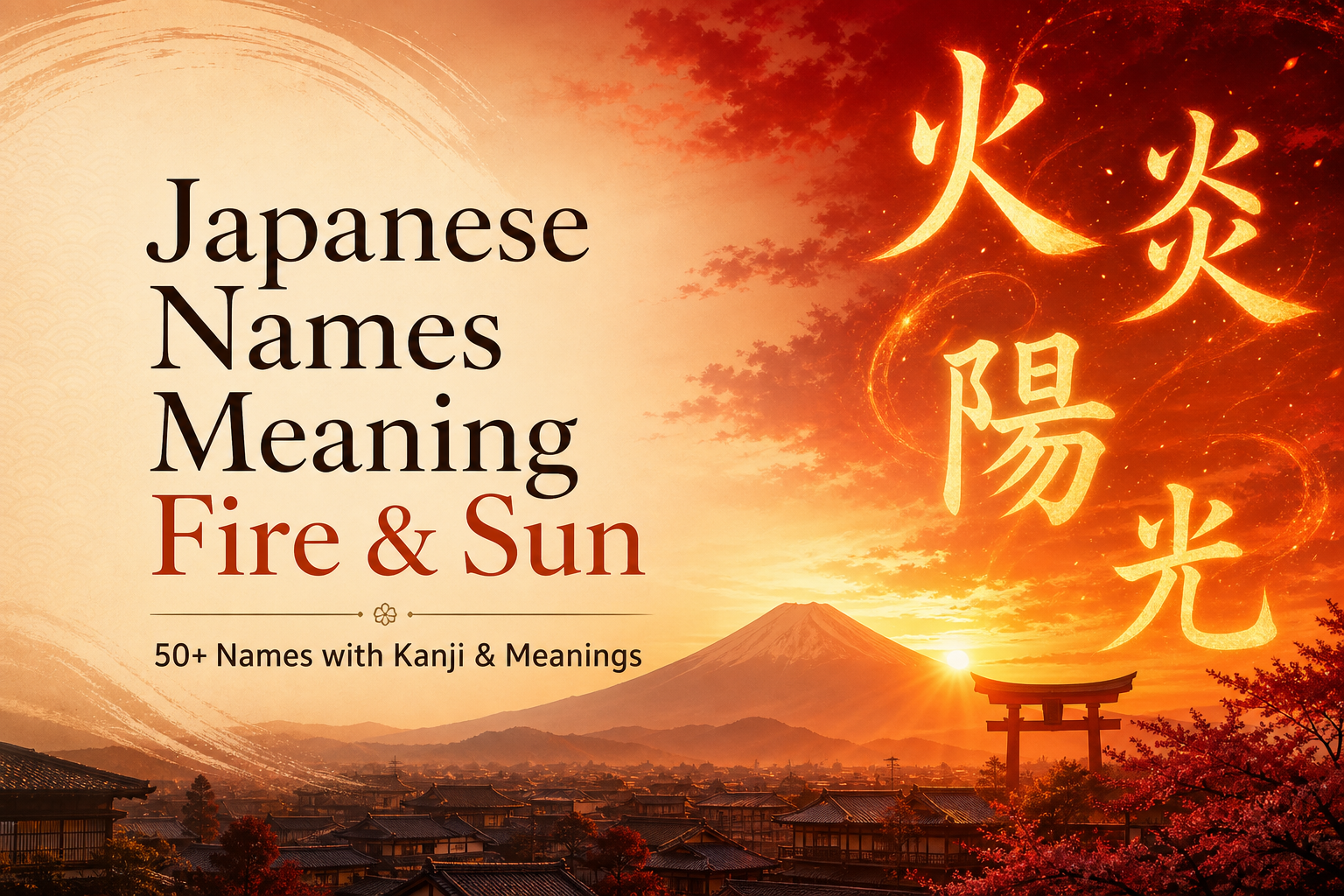
Discover 50+ Japanese names meaning fire, sun, and light, from intense picks like Homura to gentle warmth names like Hinata and Akari. Kanji, meanings, and pronunciation included.
Fire shows up in Japanese names more often than people expect, and rarely as something violent or destructive. Instead, it tends to arrive softened: as sunlight, as a small steady lamp, as warmth, as the glow left behind after a flame settles. That range is part of what makes fire-themed names so flexible, since a single idea can swing from gentle and graceful to bold and commanding depending on which kanji carries it.
This guide gathers 50+ Japanese names meaning fire, sun, and light, organized by boy, girl, and unisex picks, with kanji, meaning, and pronunciation for each.
Today's Article: Fire & Sun Names to Watch (June 17, 2026)
If you want a fire-themed name that still feels gentle in daily life, start with Hinata (陽向), Akari (灯/明里), and Hikari (光). These names carry warmth and brightness without sounding aggressive, which is exactly why they stay popular across generations. For a stronger, more dramatic tone, Homura (炎) is the standout: short, memorable, and unmistakably flame-centered.
A useful naming shortcut is to pick the feeling first, then pick the kanji. Choose 陽 if you want sunlight and optimism, 光 for clarity and elegance, and 炎 or 火 when you want intensity and edge. This way, even if two names sound similar, the written form communicates the exact personality you want.
Why Fire Names Rarely Feel Harsh in Japanese
In English, "fire" name searches usually skew toward intensity. In Japanese naming culture, the kanji most often chosen for this theme lean toward brightness and warmth rather than destruction. Names built on 陽 (sun, brightness) or 光 (light) are some of the most common in Japan precisely because they read as life-giving rather than dangerous, while the more literal 火 (fire) and 炎 (flame) are reserved for names meant to feel deliberately bold or fierce.
That's also why fire-themed names work so well across very different contexts: a soft, sunny name like Hinata fits a real baby just as comfortably as a fierce one like Homura fits an anime protagonist.
Boy Names Meaning Fire, Sun & Light
1. Hinata (陽向) — "facing the sun"; one of the most popular boy names in Japan, carrying warmth without any literal fire kanji.
2. Akira (明/晃) — "bright" or "clear," a steady, classic choice that suggests intelligence as much as light.
3. Hikaru (光/輝) — "to shine," evoking glow rather than heat.
4. Kouki (光輝/煌輝) — combining "light" with "radiance," giving a sparkling, energetic feel.
5. Homura (炎) — "flame," a direct and intense choice popular in fiction.
6. Ryou (陽) with bright-kanji pairings — built around the sun-radical, often softened in compound names.
7. Akihiro — combining "bright" kanji with a broader character, giving a mature, dependable feel.
8. Kasai-rooted names — built on 火 (fire) directly, generally reserved for names meant to feel forceful.
9. Souma (蒼真) paired with sun-kanji variants — sometimes blended with brightness imagery for a clear, vivid tone.
10. You/Yo (陽) — used alone or as a root, "sun" in its plainest form.
Girl Names Meaning Fire, Sun & Light
1. Akari (灯/明里) — "light" or "small lamp glow"; soft, warm, and widely used.
2. Hinata (陽菜) — written with different kanji than the boy version, still meaning "sunny" or "facing the sun."
3. Himari (陽葵) — "sunflower," a flower defined by always turning toward the sun.
4. Hinako (陽菜子) — "child of sunlight."
5. Kurenai (紅) — "crimson," a color word closely tied to fire's glow.
6. Akane (茜) — named for a deep red dye plant, used to describe a fiery sunset sky; doesn't use fire kanji directly but carries the imagery strongly.
7. Hinoka (火乃香/陽乃華) — combining fire or sun kanji with "fragrance" or "radiance," giving either "the fragrance of fire" or "flower of the sun" depending on the spelling.
8. Yoka (陽火) — directly pairing "sun" and "fire" kanji.
9. Karen (火憐) — combining "fire" with a character meaning "pity" or "tender," producing a softened fire name.
10. Moe (萌) — "sprouting," used to suggest the very first spark before a flame catches.
Unisex Names Meaning Fire, Sun & Light
1. Akira (明/亮) — gender-flexible and one of the most recognizable "bright" names in or outside Japan.
2. Hikari (光) — "light," used for any gender, simple and direct.
3. Haru (陽) — most often read as "spring," but written with the sun-radical, it also carries warmth and brightness.
4. Yuki (幸/雪) — usually "happiness" or "snow," but some kanji choices link it to courage and inner fire rather than the literal element.
5. Kyo (杏) — primarily "apricot," occasionally chosen for the fruit's fiery orange color.
6. Kagerou (陽炎) — combining "sun" and "flame" kanji to mean something like a heat shimmer.
Choosing the Right Fire-Related Kanji
The kanji you pick changes the entire feel of the name, even when the pronunciation stays the same:
- 火 (hi/ka) — fire itself, direct and intense.
- 炎 (en/honoo) — flame or blaze, dramatic and vivid.
- 陽 (you/hi) — sun, sunlight, warmth; the gentlest of the group.
- 光 (kou/hikari) — light, suggesting glow rather than heat.
- 灯 (tou/akari) — a small lit flame, like a candle or lantern.
- 茜 (akane) — a deep red associated with fire-colored skies, without using fire kanji at all.
- 燎/焔 (ryou/honoo) — burning fiercely, rare and reserved for especially bold names.
Because most of these kanji share readings, the same sound (like "akari" or "hi") can be spelled multiple ways depending on whether a parent wants literal fire, soft sunlight, or something in between.
Final Thoughts
Whether you're drawn to the quiet warmth of 陽 (sun), the glow of 光 (light), or the directness of 炎 (flame), Japanese names meaning fire offer some of the widest emotional range in the entire naming tradition; gentle enough for a newborn, bold enough for a protagonist. Try pairing any of these with our Japanese name generator to see them rendered in full kanji, or browse our complete name database for more inspiration.
About the Author
Yuki Tanaka
Cultural researcher and linguist specializing in Japanese onomastics with over 12 years of academic study.
Last updated: