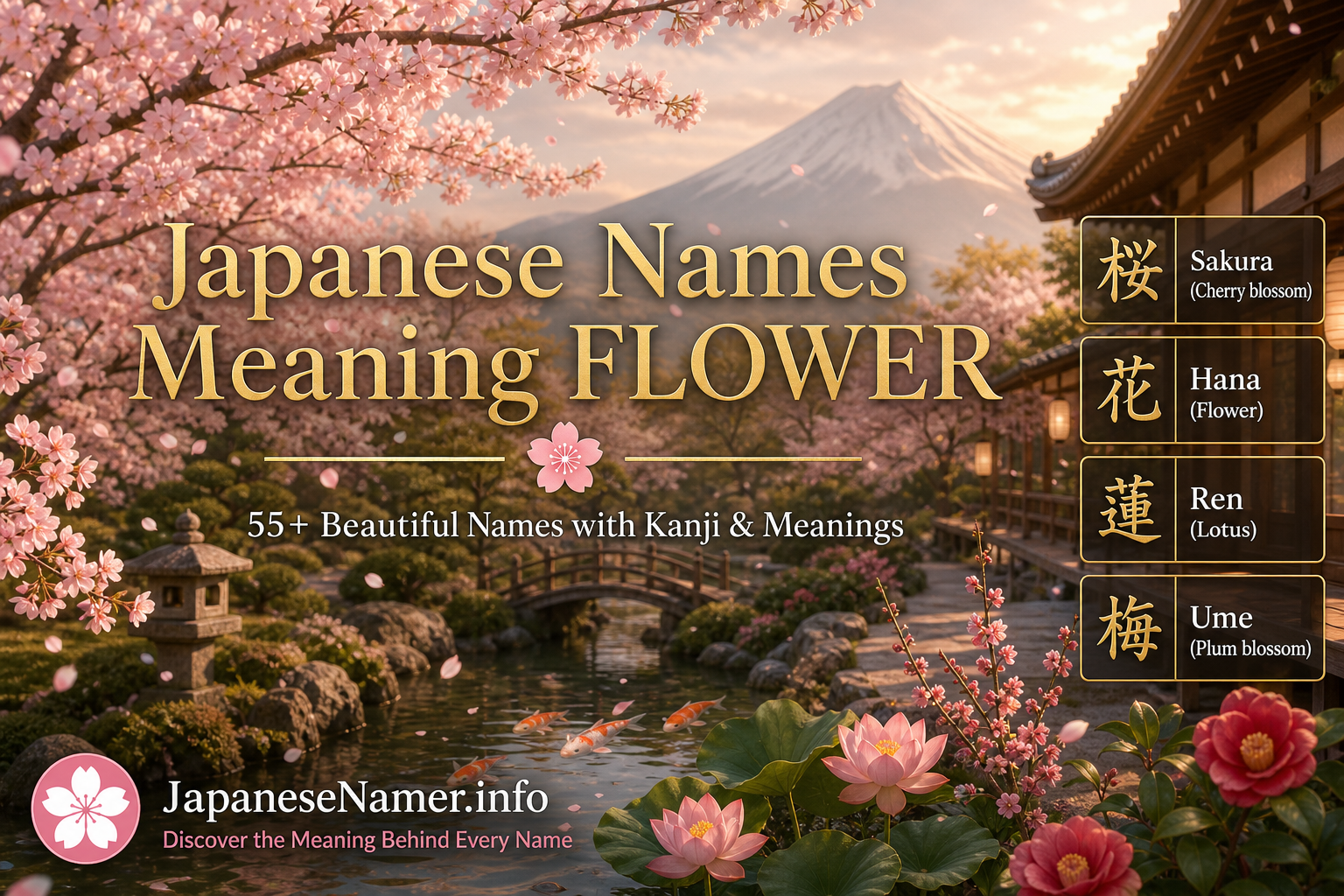
Discover 55+ Japanese names meaning flower, blossom, and bloom, including sakura, ume, hasu, ran, and more, with full kanji, readings, and cultural meanings. Perfect for baby names, anime characters, and floral-themed projects.
Few motifs run as deep through Japanese naming culture as flowers. From the fleeting cherry blossom (sakura) that opens Japan's school and fiscal year, to the resilient plum (ume) that blooms through late winter frost, floral names carry entire philosophies inside a single kanji stroke. This guide collects 55+ Japanese names meaning flower and blossom, with kanji, readings (furigana), literal meanings, and the cultural stories behind them, so you can choose one for a baby, a manga or anime character, a username, or a tattoo with real understanding of what it says.
Why Flowers Dominate Japanese Naming Culture
Japanese aesthetics are built around mono no aware, an awareness of the bittersweet impermanence of beautiful things. Flowers are the perfect symbol of this idea: they bloom, they are admired, and then they fall. That is why sakura-viewing (hanami) is a national ritual, and why "flower" characters like 花 (hana), 桜 (sakura/ō), 華 (hana/ka), and 咲 (saki) appear constantly in given names for girls, and increasingly for gender-neutral names as well.
Flower names generally fall into a few families:
- The general flower word: 花 (hana), "flower," used alone or as a suffix.
- Specific blossoms: sakura (cherry), ume (plum), hasu/ren (lotus), kiku (chrysanthemum), ran (orchid), botan (peony), fuji (wisteria), ayame/shobu (iris), tsubaki (camellia).
- Verbs of blooming: 咲 (saki/saku), "to bloom," used in names like Saki, Misaki, and Sakiko even when no specific flower is named.
- Compound elegance names: 華 (ka/hana) meaning "flower/splendor," often paired with other characters for a more sophisticated, adult-sounding name than 花.
Below, names are grouped by flower family so you can compare readings and kanji side by side.
Today's Article: Flower & Blossom Names to Watch (July 29, 2026)
If you want a floral name that feels both beautiful and culturally grounded, start with Sakura (桜), Hana (花), and Ren (蓮). Sakura is the most iconic cherry blossom name worldwide. Hana is the simplest everyday "flower" given name. Ren carries lotus symbolism and works especially well for boys.
For creators seeking softer or seasonal options, Ume (梅), Misaki (美咲), and Ran (蘭) balance perseverance, blooming beauty, and refined orchid elegance.
Cherry Blossom Names (Sakura 桜)
The cherry blossom is Japan's unofficial national flower, symbolizing the beauty of a life that is brief but fully lived.
1. Sakura (桜): "cherry blossom." The single most iconic Japanese girl name.
2. Sakurako (桜子): "cherry blossom child."
3. Saki (咲): "blossom" / "to bloom," from the verb saku.
4. Misaki (美咲): "beautiful blossom."
5. Sakiko (咲子): "blooming child."
6. Kosaki (小咲): "little blossom."
7. Haruka (春花): "spring flower," evoking the cherry blossom season directly.
8. Sae (咲笑): a rarer combination pairing "bloom" with "smile."
Plum Blossom Names (Ume 梅)
Where sakura symbolizes fleeting beauty, ume symbolizes perseverance. It blooms in the cold of late winter, before spring arrives.
9. Ume (梅): "plum blossom," a classic, slightly old-fashioned girl's name associated with quiet strength.
10. Umeko (梅子): "plum blossom child."
11. Umeka (梅香): "plum blossom fragrance."
12. Koume (小梅): "little plum blossom."
13. Umeno (梅乃): a softer, literary-feeling variant of Ume.
Lotus Names (Hasu / Ren 蓮)
The lotus rises pure and unstained from muddy water, making it a powerful Buddhist symbol of enlightenment and inner purity used for both boys and girls.
14. Ren (蓮): "lotus." Extremely popular for boys in modern Japan.
15. Renka (蓮花): "lotus flower," typically feminine.
16. Hasumi (蓮美): "beautiful lotus."
17. Renji (蓮治): "lotus governance/order," a masculine name with samurai-era resonance.
18. Renta (蓮太): "great/thick lotus," a common boy's name.
19. Hasuko (蓮子): "lotus child."
Chrysanthemum Names (Kiku 菊)
The chrysanthemum is the emblem of the Japanese Imperial family (the Chrysanthemum Throne) and represents longevity and nobility.
20. Kiku (菊): "chrysanthemum."
21. Kikuko (菊子): "chrysanthemum child."
22. Kikuno (菊乃): a graceful, classical-feeling variant.
23. Kikue (菊江): "chrysanthemum inlet," a name with a poetic, watery undertone.
Wisteria Names (Fuji 藤)
Wisteria cascades in soft purple clusters and has long symbolized love, longevity, and gentle grace. It is also embedded in one of Japan's most common surnames, Fujiwara.
24. Fuji (藤): "wisteria."
25. Fujiko (藤子): "wisteria child."
26. Fujika (藤香): "wisteria fragrance."
27. Fujime (藤女): an older-style name meaning "wisteria woman."
Peony Names (Botan 牡丹)
Known in Japan as the "king of flowers," the peony conveys boldness, honor, and dignified beauty, sometimes given to convey a strong, confident personality.
28. Botan (牡丹): "peony." Also historically used as a boy's given name and in kabuki stage names.
29. Botanko (牡丹子): "peony child."
Orchid Names (Ran 蘭)
Orchids stand for refined elegance and integrity, and the character 蘭 has a slightly old, aristocratic feel in modern Japan.
30. Ran (蘭): "orchid."
31. Ranko (蘭子): "orchid child."
32. Rina (蘭奈): combines "orchid" with a phonetic-euphony character.
33. Ranmaru (蘭丸): a historical-sounding boy's name meaning "orchid circle/perfection," famously borne by a page of Oda Nobunaga.
Iris Names (Ayame / Shōbu 菖蒲, 綾)
Iris flowers bloom around the Boys' Festival (Tango no Sekku) in May and are associated with courage and protection from evil.
34. Ayame (菖蒲 / 綾女): "iris," a name with both floral and elegant-pattern readings depending on kanji choice.
35. Ayamekoto (綾音): "iris/pattern sound," a more modern compound reading.
Camellia Names (Tsubaki 椿)
The camellia blooms in the depth of winter and, unlike most flowers, its entire blossom falls at once, giving it a dramatic, sometimes bittersweet symbolism in Japanese poetry.
36. Tsubaki (椿): "camellia."
37. Tsubakiko (椿子): "camellia child."
General "Flower" Names Using 花 (Hana) and 華 (Ka/Hana)
These names use the flower character on its own or in combination, without pointing to one specific bloom, ideal if you want floral meaning without committing to a single species.
38. Hana (花): "flower," simple and enduringly popular.
39. Hanako (花子): "flower child," a classic, almost archetypal Japanese girl's name.
40. Hanami (花美): "beautiful flower" (note: distinct from hanami, the cherry-blossom-viewing custom, though the wordplay is often intentional).
41. Hanae (花恵): "flower blessing."
42. Hanon (花音): "flower sound," a soft, musical modern name.
43. Ichika (一花): "one flower" or "flower of distinction."
44. Rinka (凛花): "dignified flower," combining coolness/dignity with bloom.
45. Yuika (結花): "flower connection/bond."
46. Kaori (香) or Kaoru (薫): "fragrance," often used alongside flower names for their scent connotation.
47. Kana (花奈): "flower" plus a phonetic-harmony character.
48. Karen (花蓮): "flower lotus," combining the general and specific flower characters.
49. Momoka (桃花): "peach blossom," celebrating the peach tree's spring flowers rather than its fruit.
50. Momoko (桃子): "peach child," a warm, classic girl's name.
51. Kaede (楓): technically "maple," but frequently grouped with floral/nature names for its blossom-like autumn color.
52. Sae (紗英): "gauze/flower petal," a delicate, poetic name.
53. Fumika (史花): "history/writing flower," pairing intellect with beauty.
54. Riko (梨花): "pear blossom."
55. Ranka (蘭花): "orchid flower," doubling the floral emphasis for extra elegance.
Boy Names That Use Flower Kanji
While most flower-specific names are used for girls, several, especially Ren (lotus), Botan (peony), and Ranmaru (orchid), are traditionally masculine or unisex. Modern Japanese parents also sometimes give boys names like Renta (蓮太), Renshi (蓮士) ("lotus scholar/warrior"), or Kaoru (薫) ("fragrance"), which soften a name with floral or scent imagery while keeping a masculine sound.
Choosing a Flower Name: Practical Tips
- Match the flower to the season of birth. Ume (plum) suits a winter birth; sakura suits early spring; hasu (lotus) suits summer; kiku (chrysanthemum) suits autumn.
- Consider stroke count if you care about seimei handan (Japanese name-fortune reading based on kanji stroke counts). Flower kanji vary widely in stroke complexity: 花 (7 strokes) is simple, while 蘭 (19 strokes) is intricate.
- Decide between the flower itself and its verb form. Saki/Sakiko (from 咲, "to bloom") reads as more dynamic and modern than Sakura or Hanako, which name the flower directly.
- For anime, manga, or fantasy characters, flower names pair well with elemental or seasonal surnames. A character named Ren or Botan feels natural alongside a surname like Kazehaya ("wind blowing") or Fuyutsuki ("winter moon").
Frequently Asked Questions
What is the most popular Japanese name meaning flower?
Sakura (桜) remains the most recognized worldwide, though Hana (花) and Hanako (花子) are more common as everyday given names within Japan.
Is Hana a common real name in Japan today, or mostly a nickname?
Hana is used as a full given name, though it also appears as a shortened nickname for longer compound names like Hanako or Hanae.
Are flower names only for girls?
No. Names like Ren (lotus), Botan (peony), and Kaoru (fragrance) are traditionally used for boys, and several flower-root names are unisex in modern usage.
What's the difference between 花 and 華, which both read as "hana"?
花 is the everyday character for "flower" as a plant; 華 carries a more elevated meaning of "splendor" or "flowering beauty" and is often chosen for a more elegant, adult tone.
Find Your Own Flower Name
Kanji choice changes meaning dramatically, and the right reading depends on the tone you're going for: direct and seasonal (桜, 花) versus refined and elegant (華, 蘭). If you want to see how a specific name looks with different kanji combinations, generate and compare options with our free tool.
Try our Japanese name generator or browse our first names collection.
Looking for more? Explore related guides on Japanese Names Meaning Wolf, Japanese Names Meaning Moon, and Cute Japanese Girl Names, or browse the full JapaneseNamer Blog.
About the Author
Yuki Tanaka
Cultural researcher and linguist specializing in Japanese onomastics with over 12 years of academic study.
Last updated: