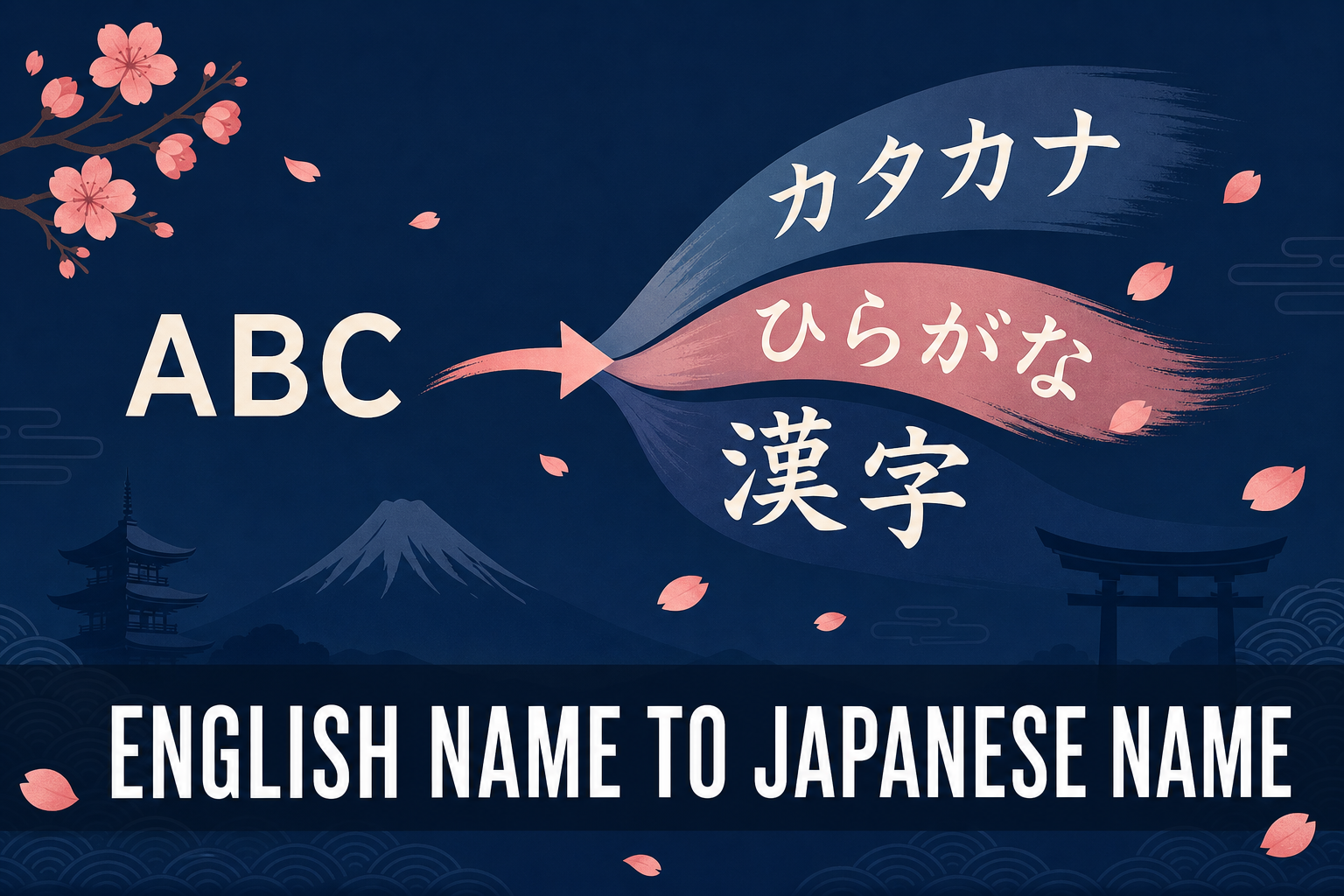
How an English name becomes Japanese: katakana for sound, hiragana vs kanji, phonetic vs meaning-based naming, and the rules Japan actually uses.
This is a guide, not a converter. It explains how an English name actually becomes Japanese: why katakana is the official script, how sounds map, when hiragana is a stylistic exception, and why kanji is a meaning choice rather than a translation.
If you already know the rules and just want the result, use the free tool: Translate Your Name to Japanese (hiragana and katakana, no signup). Come back here when you need to know why the output looks the way it does.
What This Guide Covers
This article is structured around the four questions people actually search when they want their English name in Japanese:
- Why katakana is the standard script for foreign names
- How to convert any English name sound-by-sound
- When to use hiragana or kanji instead of katakana
- Where to get a meaning-based Japanese name if a pure translation feels flat
Each section links to deeper tools and articles on JapaneseNamer for topical authority and easy user journeys.
1. Why Japanese Uses Katakana for Foreign Names
Japanese has three writing systems, and each has a role. Hiragana and kanji handle native Japanese words and grammar. Katakana (カタカナ) was specifically designed for foreign loanwords and names, making it the automatic first choice when a Japanese speaker writes a Western name.
So if someone asks "what is my name in Japanese?", the honest first answer is: in katakana. When you see a Western name in a Japanese video game, anime credits, or on a Japanese business card, it is almost always katakana.
The Three Scripts at a Glance
- Katakana (カタカナ): angular strokes, used for foreign words and names
- Hiragana (ひらがな): curved strokes, native Japanese grammar and words
- Kanji (漢字): Chinese-origin characters, each carrying meaning
Want to learn more about how the writing systems fit together? Read our guide: How Japanese Names Work.
2. How to Convert an English Name to Katakana
Katakana is a syllabic alphabet: every character represents a consonant-vowel pair (or a lone vowel). English names are converted sound-by-sound, not letter-by-letter. That is why "Michael" becomes マイケル (Ma-i-ke-ru) rather than a direct spelling.
Step-by-step conversion rules
1. Break your name into syllables as you say it out loud, not as it is spelled.
2. Match each syllable to the closest katakana sound (see table below).
3. Extend long vowels with the elongation mark ー (called a chōonpu).
4. Replace sounds Japanese lacks ("L" and "V" have no exact katakana) with the nearest equivalent (ル for L, ブ for V).
Common English Name → Katakana Reference Table
| English Name | Katakana | Hiragana | Kanji Suggestion |
|---|---|---|---|
| Emma | エマ (Ema) | えま | 恵真 (blessed truth) |
| Liam | リアム (Riamu) | りあむ | 理阿夢 (reason, hope, dream) |
| Olivia | オリビア (Oribia) | おりびあ | 織美亜 (woven beauty) |
| Noah | ノア (Noa) | のあ | 乃愛 (then, love) |
| Sophia | ソフィア (Sofia) | そふぃあ | 颯美亜 (swift beauty) |
| Lucas | ルーカス (Rūkasu) | るーかす | 琉花州 (gem, flower) |
| Ava | エイバ (Eiba) | えいば | 愛羽 (love, wing) |
| James | ジェームズ (Jēmuzu) | じぇーむず | 慈恵夢 (compassion, dream) |
| Mia | ミア (Mia) | みあ | 美亜 (beautiful Asia) |
| Ethan | イーサン (Īsan) | いーさん | 威讃 (dignity, praise) |
Skip the manual work: try the automatic name converter and get katakana, hiragana, and kanji suggestions for your specific name in one click.
3. Should You Use Hiragana or Katakana?
Both katakana and hiragana represent the exact same sounds. The difference is purely visual and contextual.
Katakana is the norm for foreign names in published contexts: passports, official transliterations, business cards, video games. Hiragana for a foreign name reads as unusual to native Japanese eyes and is sometimes used deliberately for a softer, more poetic aesthetic (e.g., in pen names or creative characters).
Quick rule: Use katakana for official, professional, or game/anime contexts. Use hiragana only when you intentionally want a softer, more native-Japanese look, and understand it will seem unconventional.
What to use where (the part a converter cannot decide for you)
| Situation | Script | Why |
|---|---|---|
| Visa, residence card, bank, HR form | Katakana | This is the legal/standard rendering of a foreign name |
| Business card in Japan | Katakana next to the Latin spelling | Japanese colleagues need to pronounce it |
| Tattoo or jewelry | Katakana *or* carefully chosen kanji | Katakana is honest; kanji is a designed meaning, not a translation |
| Anime OC, Discord, game tag | Katakana, hiragana, or a new Japanese given name | Creative use is allowed; native names belong in the [Japanese name generator](/generator) |
| Learning to read the name aloud | Hiragana as a pronunciation aid | Hiragana is a reading hint, not a replacement for katakana on forms |
The name converter will give you all three scripts. This table is how you choose which one to actually use.
4. Getting a Meaning-Based Kanji Name
Translating a name's sound into katakana is accurate, but many people want a Japanese name that carries meaning, the way native Japanese names do. That requires choosing kanji.
A kanji name works differently from katakana: instead of matching sounds, you choose characters whose meaning and pronunciation together express who you are. This is how Japanese parents name their children, and it is how creative writers, gamers, and anime fans build their Japanese alter-ego.
Two approaches to kanji name creation
- Meaning-first: decide what you want your name to mean (light, ocean, strength, beauty) and find a kanji combination that sounds good in Japanese.
- Sound-first (ateji): pick kanji whose readings approximate your English name's pronunciation, then verify the combined meaning is not awkward or accidental (a common trap: stacking pretty characters that together read as nonsense or an unintended word).
Sound-first ateji is not what Japanese parents do for a child, and it is not what a city office will put on a family register for a foreigner. It is a creative parallel: the same idea as choosing a pen name. If the ateji meaning feels forced, skip it and keep katakana, that is the version Japan will actually use for you.
Three checks before you keep a kanji rendering:
1. Each character is a real, common kanji, not a rare variant pulled for looks.
2. The combined reading is sayable in Japanese without inventing a nanori (name-only reading) that nobody will guess.
3. You would not put it on a government form. If you would hesitate, it belongs on a username or artwork, not a visa.
Our Japanese name generator lets you filter by meaning, gender, and style to find an authentic kanji combination. You can also browse 50,000+ names by meaning to find one that resonates. To hear and copy the phonetic form of your real name, go back to Translate Your Name to Japanese.
Popular kanji for Western name meanings
| Theme | Kanji Options |
|---|---|
| Light / Radiant | 光 (hikari), 輝 (kagayaki), 陽 (you): sun, positive |
| Beauty | 美 (bi/mi), 麗 (rei), 華 (hana): flower, brilliant |
| Strength | 力 (chikara), 剛 (tsuyoshi), 武 (bu/take): martial |
| Love | 愛 (ai), 恋 (koi), 慈 (ji): compassion |
| Nature / Sea | 海 (umi/kai), 空 (sora/kuu), 風 (kaze/fu): wind |
| Wisdom | 智 (chi/tomo), 哲 (tetsu), 賢 (ken): wise |
5. Seimei Handan: Does Your Japanese Name Bring Good Fortune?
Once you have a kanji name, many Japanese families go one step further: they check its fortune using seimei handan (姓名判断), the traditional practice of reading luck from the stroke count of each kanji character.
The system evaluates five pillars (go-kaku): the heavenly pillar, the human pillar, the earth pillar, the outer pillar, and the total pillar. Together they are said to reveal a name's destiny in career, relationships, and health.
Try our free Seimei Handan calculator: enter any full kanji name and get all five pillar readings with an AI interpretation in English. Or read the deep-dive: Seimei Handan Complete Guide.
6. Popular English Names in Japanese: Quick Reference
Below are the most-searched English names and their standard katakana forms, with kanji options that carry beautiful meanings.
Popular English girls' names in Japanese
| English Name | Katakana | Hiragana | Kanji Suggestion |
|---|---|---|---|
| Emma | エマ | えま | 恵真 (blessed truth) |
| Sophia | ソフィア | そふぃあ | 颯美亜 (swift beauty) |
| Isabella | イザベラ | いざべら | 伊沙美麗 (beautiful) |
| Charlotte | シャーロット | しゃーろっと | 紗羅杏 (silk, bright) |
| Amelia | アメリア | あめりあ | 雨麗亜 (gentle rain) |
| Olivia | オリビア | おりびあ | 織美亜 (woven beauty) |
| Ava | エイバ | えいば | 愛羽 (love, wing) |
| Mia | ミア | みあ | 美亜 (beautiful) |
Popular English boys' names in Japanese
| English Name | Katakana | Hiragana | Kanji Suggestion |
|---|---|---|---|
| Liam | リアム | りあむ | 理阿夢 (reason, hope) |
| Noah | ノア | のあ | 乃愛 (then, love) |
| Oliver | オリバー | おりばー | 尾理葉 (skilled leaf) |
| James | ジェームズ | じぇーむず | 慈恵夢 (compassion) |
| Ethan | イーサン | いーさん | 威讃 (dignity, praise) |
| Lucas | ルーカス | るーかす | 琉花州 (gem, flower) |
| Henry | ヘンリー | へんりー | 遍理 (broad wisdom) |
| Alexander | アレクサンダー | あれくさんだー | 有礼久 (refined, long) |
Don't see your name? Use the full name converter tool for any English name. It handles hundreds of phoneme combinations automatically.
7. Related Tools and Guides
Looking for something specific? Here is where to go next:
| What You Need | Best Link |
|---|---|
| Instant conversion | [My Name in Japanese](/my-name-in-japanese) |
| Generate a new name | [Japanese Name Generator](/generator) |
| Browse female names | [Japanese Girl Names](/first-names) |
| Browse male names | [Japanese Boy Names](/first-names) |
| Understand name meaning | [First Names by Meaning](/first-names) |
| Fortune / seimei handan | [Seimei Handan Calculator](/seimei-handan) |
| Name culture & history | [How Japanese Names Work](/blog/how-japanese-names-work) |
| Nature names | [Nature Names](/first-names#tag=nature) |
| Anime / creative use | [Japanese Username Generator](/japanese-username-generator) |
| Tattoo use | [AI Tattoo Generator](/ai-tattoo-generator) |
| Last names | [Japanese Surnames](/last-names) |
| Pet names | [Japanese Names for Cats & Dogs](/blog/japanese-names-for-cats-dogs) |
8. Frequently Asked Questions
Is it rude to write my English name in Japanese?
Not at all. Katakana exists precisely for this purpose. Writing your name in katakana is completely standard and expected in Japan when dealing with foreign names. Just ensure the pronunciation is reasonable so Japanese speakers can say it.
How do I write my name in Japanese on a visa or official form?
Government forms typically ask for katakana transliteration. Use the phonetic rules in Section 2 above, or run your name through Translate Your Name to Japanese, which outputs the standard katakana form. Some forms also accept romaji (English letters). Do not submit ateji kanji on those forms.
Can any English name be translated to Japanese?
Every English name can be transliterated to katakana because the script covers English phonemes with small approximations for L, V, and a few blends. Translation to kanji is not a fixed mapping. You choose characters. That is why two people named Emma can have different kanji and the same katakana.
What is the difference between translate and transliterate?
Transliteration converts sounds (English → katakana). Translation converts meaning (which requires choosing kanji that represent what the name means, or a meaning you want). Most English given names have no literal meaning in Japanese, so kanji choices are creative rather than fixed.
How do I know if my kanji name has a good meaning?
Check each kanji separately, then read the combined meaning out loud as a phrase. If it sounds like a slogan or a coincidence rather than a name, pick different characters or stay with katakana. You can also use the Seimei Handan calculator to check stroke-count fortune for any kanji combination.
Find Your Japanese Name Now
Ready to see your English name in Japanese? Choose your starting point:
- Phonetic conversion: My Name in Japanese (Katakana + Hiragana + Kanji)
- Generate a new name: Japanese Name Generator
- Browse meanings: 50,000+ Japanese First Names
- Check fortune: Seimei Handan Calculator
All features are free. No sign-up required.
Frequently asked questions
What is the difference between katakana and kanji for an English name?
Katakana writes the sound of your name. Kanji writes a chosen meaning whose reading may approximate that sound. Official forms in Japan use katakana. Kanji is a creative extra, not a legal translation.
Is transliterating an English name the same as translating it?
No. Transliteration maps sounds into katakana. Translation would require the English name to have a meaning you then express in kanji. Most given names have no fixed Japanese meaning, so kanji choices are interpretive.
Should I put kanji on a visa or official Japanese form?
No. Government and immigration forms expect katakana (or romaji). Ateji kanji is for tattoos, usernames, and creative use, not passports.
When would I write an English name in hiragana instead of katakana?
Almost never on official documents. Hiragana is sometimes used for a softer look in pen names or fiction. Native readers will still find it unusual for a foreign name.
About the Author
Yuki Tanaka
Cultural researcher and linguist specializing in Japanese onomastics with over 12 years of academic study.
Last updated: